
A couple of years ago I pushed our creative team into AI video production before they were ready for it. Before the clients were ready for it. There were two compelling factors:
- Video was performing so strongly in paid and organic media and we needed to find a way to help all our customers who were baulking at the cost and timeframes involved in traditional production; and
- The creative AI tools were getting stronger and I was consuming every latest output and trialling every latest edition to see how realistic and how to get the best. I am also part of a creative technologists group and were watching their own tests and discoveries.
I’ve experienced enough technology cycles to know that the learning advantage compounds. The earlier you invest in understanding something properly, the further ahead you are when everyone else catches up – and in AI creative, that gap is already significant.
The most common misconception I hear from brands is that AI video should be inexpensive because it’s just a prompt. Creating a 15-second video that builds a brand, captures attention and drives action still requires strategy, storytelling, creative direction and experience. AI has changed how we produce content. It hasn’t changed what makes content work.
The preparation is where the work actually happens
Every successful AI video starts long before anyone writes a prompt.
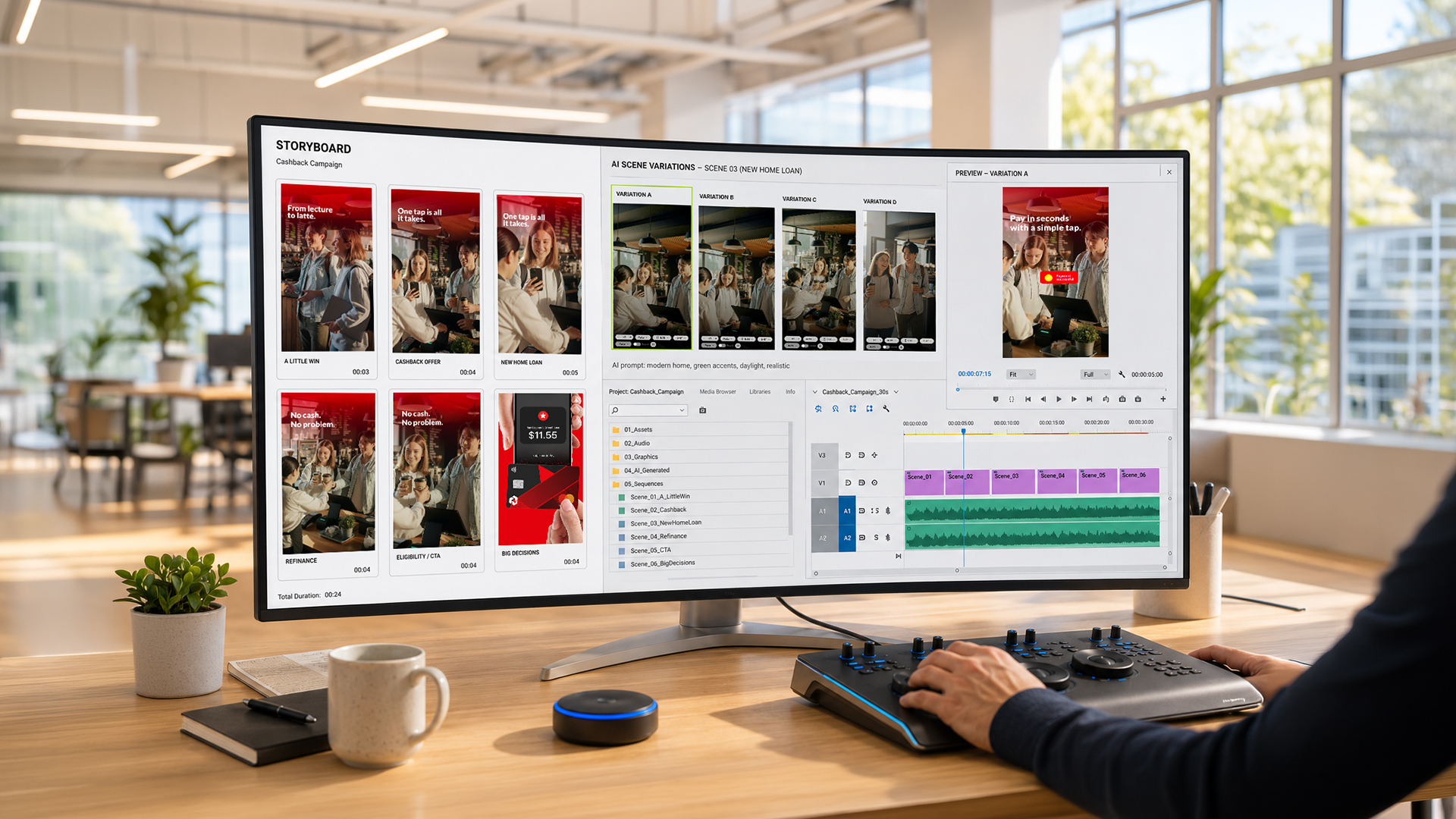
We begin with the audience, the objective and the story. What problem are we solving? What do we want someone to remember? What do we want them to do? Once that’s clear, we write the script and build a storyboard, breaking the story into a series of short scenes, typically three to five seconds each. Every scene carries a purpose. Every scene contributes to the arc. Breaking it down that way helps the overall video quality, production and aids the overall credibility.
The more thought that goes into the story and feeder images, the stronger the outcome. You can also control the IP by only inputting from royalty free inputs.
The quality of the final video is directly tied to the quality of that preparation and the details in the visual static inputs. Trying to generate an entire video in one prompt is rarely the right approach. We build scene-by-scene because it gives us far greater creative control. If one section needs improving, we regenerate that scene rather than risking the whole piece. It also means we can refine pacing, transitions and visual flow until the story feels seamless.
Consistency is one of the hardest challenges in AI video. Even with identical prompts, AI won’t produce the same result twice. Characters shift, lighting changes, colours vary, products become distorted. Maintaining continuity across multiple scenes requires careful creative direction and finishing work. It’s often the invisible work that makes the biggest difference.
The reference assets you give AI matter just as much as the prompt itself. High-quality images produce significantly better results. For product-led campaigns, providing multiple angles or 360-degree imagery gives AI a much stronger understanding of the product, preserving its proportions and detail rather than inventing them.
We’ve also learned that restraint works better than exaggeration when people appear on screen. Natural movement and subtle expressions look far more convincing than dramatic gestures and complicated interactions. Knowing where AI performs well and where it still needs human guidance is part of producing work that audiences actually trust.
The economics have shifted completely
For years, brands produced one major campaign and expected it to carry every audience, every platform and every stage of the customer journey. Production costs made anything else hard to justify. A single TVC produced every 3 years costs hundreds of thousands of dollars. Most brands produced far less creative than they needed and called it strategy.
AI has changed that equation entirely.
A $5,000 creative test today tells you what a $200,000 production budget used to take three months to tell you. And if it doesn’t work, you haven’t burnt your budget or your bridges. You iterate. The risk associated with creative decisions has dropped dramatically. The speed of learning has accelerated in the opposite direction.
At Digivizer, we’ve helped brands move from producing one major video every few years to creating 20, 30 and sometimes more than 50+ AI-assisted videos every month, and we are actively building the capacity to double that. Not because volume is the goal, but because the loop between data, creative and decision has to be fast and continuous to work properly. And AI creative has opened up opportunities for every brand. Every video is built for a specific audience, a specific moment, a specific stage of the buying journey. Every result feeds back into the next round.
That’s how creative compounds.
These platforms are hungry. Most brands aren’t feeding them.
Creative is the new targeting. As platforms like Meta and TikTok get extraordinarily good at finding the right audience, the competitive advantage shifts to the creative itself. The platforms reward brands that give them enough signal to work with. A handful of generic assets just won’t do it.
Consumers expect relevance now. The algorithms on TikTok and Meta have trained people to expect content that speaks directly to them. When it doesn’t, they don’t just ignore it, the platform stops serving it altogether and you never reach that person.
Most brands simply don’t have enough creative in play. For instance, a first-home buyer looking at a one-bedroom apartment in the inner-city suburbs needs to feel seen, completely differently from a growing family, a downsizer moving to the coast, or someone buying regionally. Those are different stories, different scripts, different moments in someone’s life. One piece of creative will not reach all of them. You need many and you need to update them continuously.
Retainers are coming back for exactly this reason. Not because the agency model is the same as it was, but because these very hungry platforms need a constant supply of new assets to optimise toward. What brands need from their agency partner is a team who can create more, faster and consistently better, not a campaign with a start date and an end date.
Scale without strategy is just more content
AI allows brands to create at a volume that simply wasn’t commercially viable before. But scale without genuine creative thinking and performance data creates more noise, not better marketing.
If you’re thinking about AI video as a way to produce content more cheaply, you’re only seeing part of the opportunity. In addition to great strategy, you still need strong creative and branding specialists, and brilliant motion designers who have harnessed the best in AI creative tools. And you definitely need strong and fast approval processes.
The investment hasn’t disappeared. It’s shifted. Less goes into production crews, locations and lengthy schedules. More goes into understanding customers, developing sharper stories, testing more variations and using what the data tells you to improve the next round. That’s a trade any marketer should be willing to make.
If you’re still measuring the value of AI creative by what it costs to produce, you’re asking the wrong question. The right question is what it costs not to.